TO BE NO. 1 AMONG COUNTRIES IN THE REGION OR THE WORLD?
If you said yes to the above question and you were a Malaysian, congratulations!!! Your country has struck another 1st in the ASEAN region. Malaysia has the highest public debt to the country's gross domestic product among the 10 ASEAN countries. Yes, we are ahead of Indonesia, Philippines, Laos, Cambodia and Vietnam. This record did not come easy. Malaysia had to run 15 years of govt budget deficit consecutively to attain this title.
Extracted from The Edge. All rights belong to The Edge
This attainment should rightfully goes into Malaysia Book of Records. No previous prime minister in Malaysia before Najib Tun Razak had managed to achieve this feat. Further, Najib has creatively used 1Malaysia Development Bhd (1MDB) as a secretive investment arm to raise no less than RM40 billion debt on behalf of Malaysian Govt. The debt of 1MDB, on paper, is not included as Malaysian govt debt since it is considered 'off balance sheet' although Malaysian govt is still responsible for it. Read more about 1MDB's secretive history here: http://www.theedgemalaysia.com/highlights/249308-highlight-special-report-debt-laden-malaysian-fund-stirs-controversy.html
The man behind 1MDB, Low Taek Jho or also known as Jho Low, is helping Najib to indiscriminately raise huge debts under 1MDB for at times inexplicable reason, vaguely called development. We do know that Jho Low has a history of very high society lifestyle. He can splash money like pouring water when it comes to spending time with the world's celebrities. Who's money is he spending? Read more about Jho Low here.
Jho Low side view
Jho Low (in black) front view
More intriguingly, Najib instructed 1MDB to raise USD3 billion just 2 weeks before he called forMalaysian general election on 5 May 2013. A prestigious American/Jewish bank, Goldman Sachs did the job for 1MDB at a cost of USD500 million. Yes, you have read it correctly, USD500 million. An astonishingly lucrative deal for Goldman. Reported by international Bloomberg news, Goldman could not get any deal close to this kind of lucrative profit from raising debts or bonds for other Asian countries.
According to The Star newspaper in Malaysia, Jho Low is a financial genius who has started investing successfully at very young age. He simply could not be so dumb and failed to negotiate a more sensible deal with Goldman. Was Jho Low getting a kickback from the deal at the expense of Malaysians? Who is the dumber here- Jho Low, Najib or Malaysian? Read more about the USD3 billion debts raised by Goldman here: http://www.bloomberg.com/news/2013-05-08/goldman-said-to-earn-500-million-arranging-malaysia-bond.html
Najib's cavalier attitude of raising USD3 billion by paying USD500 million and having channeled the USD3 billion to a tax haven Caymen Island company before general election in Malaysia raised many eyebrows domestically and internationally. General public in Malaysia has been deprived of the extent of this problem. Malaysian media is not known to have fair or balanced reporting. Najib simply ignored the matter and did not seem to care. Financial Times in United Kingdom reported this highly dubious transaction here: http://www.ft.com/cms/s/0/ed31cbde-b222-11e2-8540-00144feabdc0.html#axzz2dueyteZL
If you think about it, USD500 million equals to RM1.6 billion. If Najib had not spent the USD500 million on Goldman's fee, Malaysian govt would not need to raise price of petrol and diesel by 20 sen per litre recently just to save RM1.1 billion for the govt. You can see why the ordinary Malaysians are unhappy.
There is some
form of fascination with toilet in Malaysia recently. No help was given by the Malaysian
authority when Muslims had to pray in or within a public toilet due to lack of
surau or Muslim prayer room. Toilet had sadly become some Muslims’ de facto surau.
Indirectly, this was condoned by Malaysian Islamic authority in Perak. The
authority did not take any action to date. This has however not been made public news.
You can further read
about how a Malaysian school made a fashionable twist by creating an eating canteen out of a bathroom/changing room, side by side a toilet. No kidding. I
would however not say that this should be a general trend in Malaysia.
The Malaysian fascination
or great tolerance for toilet is not shared in their tolerance for other
religions. Malaysian government agency under the ruling Barisan Nasional regime could be very intolerant when it came to
other religions using surau or Muslim prayer room as a place for prayer or
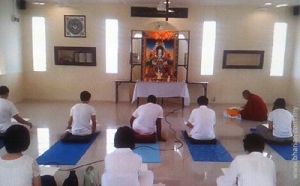
meditation. This act of Buddhist meditating in a surau has been made widespread public news and covered extensively by local newspapers.
Buddhist Meditation in a Surau
The owner of a
resort, who allowed the resort’s surau to be used by Buddhists in meditation,
had been arrested. The owner is a Muslim himself. His Permanent Residence status in Malaysia has since been revoked although it was not clear what his crime was. The surau has also been demolished my the Malaysian authority despite strong objections to the demolition.
Surprisingly, Parti Se-Islam Malaysia, PAS took a different perspective to the whole incident. PAS was more keen to look at the cause of the problem and had discreetly advised against over reaction to the meditation issue and other deemed sensitive incidences. A statement released by PAS:
Orang kita memang sensitif…
Orang kita memang sensitif dengan berita surau diguna oleh non-muslim baru-baru ini, baru sedar selama ini rumah-rumah Allah banyak yang sunyi.
Orang kita memang sensitif dengan berita tokoh agama poligami, baru sedar ramai rupanya selama ini anak-anak kita ramai berpacaran tanpa nikah tapi sudah seperti laki bini.
Orang kita memang sensitif dengan video menyambut raya sambil pegang anjing atau babi, baru sedar selama ini banyak adegan lelaki perempuan bukan muhrim berpegang tangan berpeluk-pelukan setiap hari disiarkan di TV.
Orang kita memang sensitif dengan berita tulisan selamat hari raya dicetak terbalik dalam tulisan jawi, baru sedar selama ini AlQuran yang dicetak betul hanya hiasan almari.
Orang kita memang sensitif dengan isu gadis Melayu menyertai pertandingan ratu cantik tidak menutup aurat nampak body, baru sedar selama ini ramai gadis Melayu tanpa masuk pertandingan ratu cantik pun berpakaian begini.
Orang kita memang sensitif dengan berita makanan yang disyaki ada DNA babi, baru perasan sebenarnya rokok yang ramai hisap memang sudah difatwakan haram selama ini.
In contrast, this intolerant, which seems to be confined mainly to the ruling regime UMNO supporters in Malaysia, was not shared by Egyptians. Egyptian Muslims were holding hands and form a protective circle to protect a church and the church-goers.
Muslims ringing and protecting the Coptic Church of St. George in Sohag, Egypt
At the same time, a team of Egyptian Christians forming a massive human shield to protect their Muslim countrymen as they prayed during the violent protests.
There is such a phenomena of Muslims defending churches, Christians protecting Muslims during Friday prayer in Egypt.
Christians in Britain seem to have a more liberal view these days when it comes to religions and prayers. Hundreds of Muslims were able pray in a
nearby Church during bitter cold and snowing winter. You can read the BBC news further here.
Across the border of Malaysia in Southern Thailand, there was a totally different situation. Buddhist monks have been seen to have regularly prayed alongside Muslims in mosques. They ate together too. I am puzzled and find it impossible to explain the Thai religious harmony in sharp contrast to Malaysian intolerant.
Buddhist Monks and Muslims eating together
Buddhist Monks and Muslims in Southern Thailand
There was no explanation of any specific reason why the Buddhist monks were regularly praying together with Muslims. The above Southern Thailand photographs were extracted from and with credit to news portal HERE and blog HERE.
Given the great tolerance or fascination with toilet but intolerance for religious co-existence in Malaysia, it is perhaps not a good situation for the country to be in. What do you think?
While you are enjoying your food at home, think of
other places that you can have your meal ...
While you may imagine all these themed restaurants around the world, you may not be able to imagine that a Malaysian school has taken the concept to a greater height by actually setting up a 'canteen' within a real bathroom/changing room in a school, Sekolah Kebangsaan Seri Pristana, Sungai Buloh, Selangor, Malaysia.
Surprisingly, the school's facebook page did not highlight or mention this highly creative way of having a meal for the students. However, it has been reported that presumably the teachers and parents/guardians of students also had their 'buka puasa' or breaking fast in the 'canteen' recently. It was unclear if the 'buka puasa' or breaking fast event was one-off or a daily affair during the Ramadhan or fasting month.
It was indeed very interesting to see how the school's teachers, parents/guardians and students were so supportive of the idea of eating their meals in this 'canteen' within a real bathroom/changing room.
The excitement of eating in this 'canteen' is perhaps heightened by the fact that this bathroom/changing room 'canteen' is situated right next to the school's toilet. Their entrance doors are literally located side by side. Tandas is a Malay language for toilet. Seri Mawar is the name of the toilet. The below picture is enlarged for better visibility of location.
There are several strangely themed restaurants around the world. You may have come across a toilet themed restaurant in Taiwan, called Modern Toilet. This restaurant is popular with locals and tourists in Taipei. The same restaurant by Modern Toilet can be found in Japan, Hong Kong and China.
Although Modern Toilet's concept is popular, it is just a toilet themed restaurant and not an actual restaurant situated within a real toilet. The concept of an actual canteen situated within a real bathroom/changing room is far more fascinating. We must remember that this bathroom/changing room 'canteen' is located right next to a real toilet too.
This bathroom/changing room 'canteen' idea by the school's the headmaster, Mohamad Nasir Mohd Nor is ingenuously creative. He was instrumental in setting up this bathroom/changing room 'canteen'. One might be curious if he practiced what he preached at home by eating his meals at home in toilet or bathroom. Mohamad Nasir's creativity may soon earn him a lecturer post in Malaysian very own LimKokWing University of Creative Technology. It is perhaps his active political involvement that has given him the edge in his creativity. His creativity has however not gotten the same support from his political allies.
I reckon that this bathroom/changing room 'canteen' is definitely one of the top 10 unique places to eat in the world. What do you think?
It is exciting to read the below article by Reuters which is not about Najib Tun Razak but it points to several of his characters. My humble opinion of what the below article has prompted me on the traits of Najib. Let me elaborate on the 4 broad traits that I gather.
NON-REFORMIST OR 'TRANSFORMER'-
There had been so many discussions among Najib and his advisers on what should be done in Malaysia just before Najib became a prime minister in Malaysia. Najib came out with New Economic Model (NEM) as his reform agenda. The whole grand plan launched with much fanfare has pretty much disappeared today. NEM is no longer mentioned in any mainstream media.
Najib recently gave out RM500 to voters right before the country's general election, which was dressed up glamorously by public relation firm and called BR1M (Bantuan Rakyat 1Malaysia). He also set up sundry shops which have political branding and are called KR1M (Kedai Runcit 1Malaysia). These sundry shops are heavily subsidized by Najib's govt but most of the subsidy went to the retailer group, Mydin, as opposed to the people. It suddenly appeared that BR1M and KR1M were transformational development in Malaysian economy. At least, that was what the public relation firm of Najib wanted the people to believe. 'Promises fulfilled' apparently. I can not recall that BR1M and KR1M were part of NEM or any economic programme.
CORRUPT-
As the Prime Minister of the country for 4 years, Najib seemed powerless when it came to fighting corruption despite his repeated calls to tackle corruption. Najib has not got a history of being 'CLEAN'. His newly created flagship governmental investment arm, 1MDB (1Malaysia Development Bhd) has been reported to have siphoned RM7 billion into a Caymen Island '1MDB' company. One will naturally ask why would that be necessary? 1MDB has been raising money with Malaysian government guarantee and support incurring more debts for the country. According to international business news, Bloomberg, Golman Sach recently made a handsome USD500 million profit from raising USD3 billion for 1MDB. Who would disagree that the amount of profit is exorbitant?
More interestingly, Najib's brother, Nazir had 'told' his staff that CIMB Bank would never not allowed to lend money to 1MDB. Hence, they were not supposed to pursue 1MDB's fund raising even if the deals are extraordinarily lucrative. That much confident Nazir had for 1MDB. Nazir is the CEO of CIMB Bank, the 2nd largest bank in Malaysia. On the other hand Maybank, the largest bank in Malaysia, is known to be a big lender to 1MDB. Maybank's CEO, Abdul Wahid Omar, is widely known to be a political appointee. He has since joined Najib's recently announced cabinet as a minister.
INDECISIVE-
Najib has been a Prime Minister since 3 April 2009. He has not still been able to decide what role should he play for this country. Najib's indecisiveness has kept Malaysians in the dark as to whether he is a liberal reformist
or just another UMNO hardline leader. He appears to be both most of the
time. He talked about racial harmony among the people but he supported PERKASA, a racist organization at the same time. Najib recently wrongly accused Chinese voters in Malaysia for causing the drop in seats won by his BN (Barisan Nasional) coalition, which was termed Chinese Tsunami. The real cause was the drop of supports by better informed urban folks using modern social media against rural folks who still relied on govt media. Various statistics have proven this point. Najib's fickle minded claim did not earn him much credit.
CROWD PLEASER-
Najib is very serious in getting votes during an election. We just need to look at the speedy implementation of BR1M and KR1M to know that. He is known to have said 'You help me, I help you' to voters before agreeing to allocate govt funds to the constituency during a Parliamentary by-election. However, it is less clear when we try to see the principles that he believes in or his improvement plans for Malaysia going forward. Implementing some property and physical infrastructure projects in the country
is far from improving or achieving better socioeconomic conditions of
Malaysians. These are mostly over-priced projects awarded to UMNO's cronies without open tender.
You can watch the 'You help me, I help you' live speech from the below video starting from 50 seconds onwards. He also made reference to the same 'You help me, I help you' deal made in a previous by-election.
In order to appease his crowd, Najib says different things in different venues. He often contradict himself within days of making a statement. While the mainstream media has avoided highlighting his inconsistency, his flip-flops or U-turns are still glaring to Malaysians.
Do you agree with my impression of the below article on Najib?
------------------------------------------------
KUALA LUMPUR: Malaysia’s divisive election has left a bitter taste for
millions of people that risks creating a long-term problem of legitimacy for
Prime Minister Najib Tun Razak’s long-ruling Barisan Nasional (BN) coalition.
The outrage was clear at a busy intersection across from one of Kuala
Lumpur’s fanciest shopping malls, where a huge poster of Najib and his deputy
had been defaced — a rare display of public disrespect in the Southeast Asian
nation.
One of the scrawled comments poked fun at the unconvincing share of the
votes won by Najib’s ruling coalition in its May 5 election victory: “47
percent PM,” it said.
“If you don’t like it, you can leave,” mocked another, alluding to a comment
by Najib’s new home minister that those unhappy with the result — and the
electoral system that produced it — should pack up and emigrate.
The tense political atmosphere threatens to prolong policy uncertainty that
investors hoped the polls would put to rest, as Najib braces for a possible
leadership challenge and the opposition mounts a noisy campaign to contest the
result.
By securing 60 percent of parliamentary seats with less than 50 percent of
the popular vote, the BN’s victory has served to expose starkly the unfairness
of a gerrymandered electoral system that is also prone to cheating and bias.
That has galvanized the opposition, led by former deputy prime minister
Anwar Ibrahim, into holding a series of big rallies as it refuses to accept the
result and prepares legal action to challenge the outcome in nearly 30
close-run seats.
Disgruntled Malaysians have submitted over 220,000 signatures to the White
House online petition page, exceeding the number required for a response from
President Barack Obama.
In response, divisions have appeared in Umno, the main party in the ruling
coalition — in power since independence from Britain in 1957.
Hardliners have urged a crackdown on dissent and blamed minority ethnic
Chinese voters for deserting the ruling coalition. That has raised racial
tensions in a country whose ethnic Malay majority dominates politics and enjoys
special privileges to offset what its leaders see as its disadvantaged position
compared to relatively wealthy ethnic Chinese.
Reformers have urged Najib to press ahead with social and economic reforms
to blunt the opposition’s appeal and address the concerns of discontented young
and urban voters. That includes many ethnic Malays who voted for the
opposition.
“Every day Najib sees angry Malaysians on the Internet. It is not an easy
thing to swallow,” said a senior government official who declined to be
identified. “There are people in his cabinet asking for a crackdown and there
are others asking for him to brandish his reformist side.”
The hard liners appeared to gain ground last week when police used the
colonial-era Sedition Act to detain three opposition politicians and activists
and charged a student with inciting unrest.
The three arrested were later released after a court rejected the police
remand order, but could still face charges.
Najib is under pressure from Umno conservatives such as Dr Mahathir Mohamad,
who served as prime minister for 22 years, to show a tougher side ahead of a
leadership election that could be held as early as August. At least until then,
planned reforms such as steps to widen Malaysia’s tax base and reduce heavy
food and fuel subsidies are likely to stay on hold.
“Najib is not in a very strong position,” Mahathir told reporters in Tokyo
on Saturday, saying there was a risk that his majority could be weakened
further if some ruling coalition politician defected to the opposition.
“When you are concerned about that, the focus on development, economy and
all that will be affected. That is Najib’s problem.”
Fraud claims
The opposition has yet to present clear evidence of widespread fraud, but
Reuters interviews with 15 polling agents give an indication of why many
Malaysians have lost faith in an electoral system that clearly favours the
governing coalition.
A majority said that officials of the Election Commission (EC), which is
part of the Prime Minister’s Department, did not follow procedures or were
ill-equipped to oversee the polls.
“Some, not all, officials were not trained enough or did not have the
experience to determine what was a spoiled vote,” said a counting agent in the
Segamat parliamentary seat in southern Johor state, where the BN candidate won
by a slim 1,200 majority with 950 votes deemed as spoiled.
“I cannot speculate on whether it was deliberate but there was quite a bit
of incompetence,” said the agent, who declined to be identified due to the
sensitivity of the issue.
Anwar’s three-party alliance says it has evidence that BN officials bought
votes with cash and transported immigrants granted citizenship on shaky grounds
to vote in areas with close races.
While its legal action, due to be filed with courts around the end of May,
is unlikely to succeed, it will keep the electoral fraud issue in the spotlight
for months ahead.
In Selangor state near Kuala Lumpur, a Reuters examination found at least
2,000 voters had identity cards deemed “dubious” by a commission of inquiry in
Sabah. That commission is investigating longstanding allegations that the
ruling coalition handed out citizenship for votes to immigrants.
The government denies the fraud claims, accusing the opposition of being
sore losers and of trying to stir up an Arab Spring style revolt. The EC says
it took a tough approach in eradicating possible fraud in the electoral rolls.
“The opposition did not lose because of election rigging, it lost because
they did not get the vote,” EC chairman Abdul Aziz Mohd Yusof told Reuters.
Deep concerns over the integrity of Malaysia’s elections are nothing new.
The government has been shaken by huge street rallies in recent years organized
by the influential Bersih movement that has called for sweeping reforms,
including a clean-up of the electoral roll and equal access to media.
After a violent police response to a 2011 rally, Najib burnished his reform
credentials by rolling back some draconian security laws and introducing
limited electoral reforms.
Reform dilemma
Bersih says those reforms did not go far enough, and is refusing to recognize
the election results until it has verified hundreds of allegations of fraud in
a “people’s tribunal”. It has previously highlighted instances of voters over
120 years of age and hundreds of voters living at a single address.
Likely far more influential than fraud are electoral boundaries that have
been manipulated over the years to favour the BN. Pro-opposition constituencies
in urban areas have up to nine times the number of voters than pro-government
seats.
The opposition won just 89 seats in the 222-seat parliament, despite winning
more than 51 percent of the vote.
“Najib won on malapportionment rather than his policies to eradicate
corruption and reform the economy as voters felt he wasn’t sincere,” said Ooi
Kee Beng, Singapore-based deputy director of the Institute of Southeast Asian
Studies.
Najib, the 59-year-old son of a former prime minister, is unlikely to
countenance deeper electoral reforms, a move that could be political suicide
for the BN.
Reformists within Umno are urging him, however, to ignore calls for a
security crackdown and push ahead with steps to tackle corruption and make the
ruling coalition more appealing to urban and ethnic Chinese voters who have
deserted it.
“Of course the debate on whether we are truly a majority government will go
on. But we can gain respect from the people,” said Saifuddin Abdullah, a
prominent reformist who is a member Umno’s Supreme Council.
Someone that I know has found a Malaysian Identification Card (I/C). He is eager to return it to the rightful owner of the I/C. Malaysian media and authority have not been helpful. He somehow managed to get some help from a Taiwanese TV station. Its friendly gesture of putting the I/C in the news was nice but understandably inadequate in Malaysia. Please spread this around. Do you know the owner of this I/C? Is he one of your friend? Please help...
Papaya son/of Cabbage (name translation)
Little did we know that there is actually a genetic relationship between papaya and cabbage. While you are busy helping to find the owner of this I/C, I have attached a complimentary music video clip and a cartoon below to keep you entertained.
P/S: Please inform me if there is any infringement of copyright, The video or cartoon will be taken down immediately. There is no intention to lie, cheat or to be a copycat.


 Najib's cavalier attitude of raising USD3 billion by paying USD500 million and having channeled the USD3 billion to a tax haven Caymen Island company before general election in Malaysia raised many eyebrows domestically and internationally. General public in Malaysia has been deprived of the extent of this problem. Malaysian media is not known to have fair or balanced reporting. Najib simply ignored the matter and did not seem to care. Financial Times in United Kingdom reported this highly dubious transaction here: